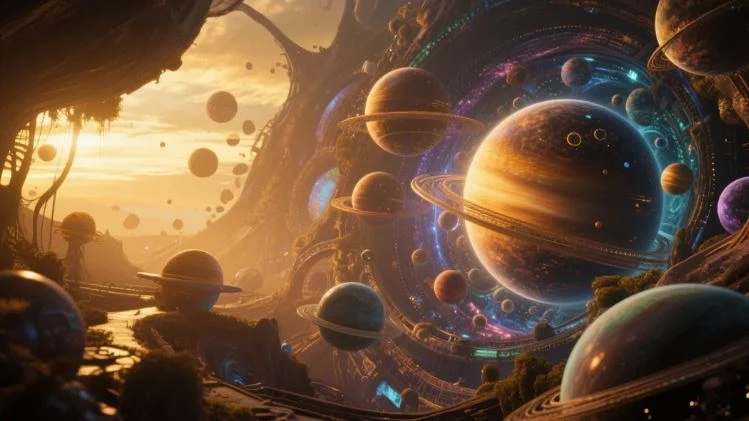
What is the Multiverse? A complete A-Z guide to the mind-blowing theory of multiple universes—from quantum physics and eternal inflation to Marvel, DC, and Everything Everywhere All at Once.
Who Is This Article For?
You’re 18–35 years old, probably reading this on your phone right after finishing Doctor Strange in the Multiverse of Madness or the latest season of Rick and Morty. You’ve heard the word “multiverse” a thousand times, but you still don’t fully get whether it’s real science or just Hollywood magic. You’re a student, programmer, designer, physics enthusiast, or simply someone who’s deeply curious about the universe and existence itself. You want to understand this concept so you can confidently join (or win) any conversation about it. This article was written exactly for you.
What Will This Article Give You?
A crystal-clear answer to “What is the multiverse?” without needing a PhD. All the major scientific theories explained in plain English: Max Tegmark’s 4 levels, Many-Worlds Interpretation, String/M-theory, bubble universes, and more. Why Marvel, DC, and even Oscar-winning films like Everything Everywhere All at Once are obsessed with the same scientific idea. Enough knowledge to sound smart the next time the topic comes up with friends or colleagues.
Why Should You Read Until the End?
Because deep down you’re wondering: “Is there another version of me out there living a better, richer, happier life?” Because the next time you watch Spider-Man or Loki, you’ll actually understand what’s happening instead of just going “wow, cool.” And because this might be the rare article that’s both rigorously scientific and as entertaining as a blockbuster—without putting you to sleep.
Ready to dive into the biggest mystery in modern cosmology? Let’s go!
What Is the Multiverse? The Simplest Definition You Need
The multiverse is the idea that our universe is just one of an enormous (possibly infinite) number of separate universes that exist simultaneously. Each universe can have different physical laws, constants, histories, and outcomes.
In plain words: The universe we live in might be just one tiny bubble in an infinite ocean of other universes. Somewhere out there could be an Earth where you’re the president, or an Earth where humans never evolved.
Unlike the traditional “Universe” (everything that exists), the “Multiverse” says that “everything” is actually way, way bigger.
History: The Idea Is Over 2,000 Years Old
This isn’t just a modern concept:
- In 50 BC, Roman poet Lucretius wrote that countless worlds are born and die in the infinite void.
- Ancient Greek atomists like Democritus believed in infinite worlds, some similar, some completely different.
- In the 16th century, Giordano Bruno was burned at the stake partly for claiming there are infinite inhabited worlds.
- 1957: Hugh Everett proposed the Many-Worlds Interpretation—the first serious modern physics version of the multiverse.
The Core Scientific Theories Behind the Multiverse
Max Tegmark’s 4-Level Classification (The Easiest Way to Understand It)
MIT physicist Max Tegmark divided the multiverse into four levels from “most believable” to “most mind-bending”:
Level I: Beyond Our Observable Horizon Our universe is expanding faster than light can travel. There are regions forever beyond what we can see. Pure statistics says that, far enough away (about 10¹¹⁵ meters), there are almost exact copies of our observable universe—and you.
Level II: Bubble Universes According to eternal inflation (Alan Guth, Andrei Linde), our universe is just one “bubble” in an infinite inflating sea. Other bubbles have different physical constants—gravity could be stronger, electrons heavier, life impossible or completely alien.
Level III: Quantum Many-Worlds Interpretation (MWI) Every time a quantum event has multiple possible outcomes (e.g., an electron goes left or right), the universe splits. All outcomes happen—in separate, non-communicating branches. This is the exact theory behind Everything Everywhere All at Once.
Level IV: The Ultimate Ensemble Every mathematically possible structure exists physically. Our universe is just one of countless others described by different mathematical laws. This level is almost pure philosophy.
Other Major Models
Brane Multiverse From string theory and M-theory: Our universe is a 3-dimensional “membrane” (brane) floating in a higher-dimensional space. Collisions between branes can trigger new Big Bangs.
Cyclic Multiverse The universe expands → collapses (Big Crunch) → bounces → repeats forever. Each cycle is a separate universe.
The Multiverse in Pop Culture – When Science Meets Hollywood
Marvel Cinematic Universe (MCU)
Loki introduced the Sacred Timeline and Variants. Spider-Man: No Way Home and Doctor Strange in the Multiverse of Madness took it to the next level—different versions of the same heroes from other realities meeting.
DC Comics & DCEU
DC has been doing multiverses since the 1950s with Earth-1, Earth-2, etc. Crisis on Infinite Earths (1985) and Flashpoint are legendary events. The Flash (2023) movie is 100% multiverse-driven.
Other Masterpieces
- Everything Everywhere All at Once (2022): The most scientifically accurate (and emotionally powerful) multiverse movie ever made.
- Rick and Morty: Hilarious, dark, and surprisingly philosophical take on infinite realities.
- His Dark Materials (Philip Pullman): Mystical multiverse.
- Dark (Netflix): Multiverse + time-loop masterpiece.
Conclusion: Are We Actually Living in a Multiverse?
Right now, there is no direct experimental proof. However, the multiverse is the cleanest solution to many deep problems in physics:
- It explains why the constants of nature are perfectly fine-tuned for life (anthropic principle).
- It removes the need for wave-function collapse in quantum mechanics.
Giants like Stephen Hawking, Brian Greene, Max Tegmark, and Sean Carroll think it’s likely real. Critics like Sabine Hossenfelder and Paul Davies call it “unscientific” because it may be untestable.
True or not, the idea of the multiverse has completely changed how we see our place in reality. Right now, in another universe, you might be reading this exact article—with a completely different ending.
Which multiverse theory do you find most convincing? Drop your thoughts in the comments—I’d love to hear them!
Want exclusive “Top-Secret” 2025 materials on quantum physics and the multiverse? Sign up now at https://otherlogics.com/
Frequently Asked Questions
Is the multiverse real? No direct evidence yet, but it naturally emerges from several well-accepted theories (inflation, quantum mechanics). Many top physicists believe it’s highly probable.
Who first proposed the modern multiverse? Hugh Everett in 1957 with the Many-Worlds Interpretation. The actual word “multiverse” was coined by philosopher William James in 1895 (in a different context).
Does the multiverse affect our daily lives? Not directly—yet. But if Many-Worlds is true, every choice you make right now is creating countless other versions of you.
Can we ever travel between universes? According to current theories: no. Level I universes are too far, Level III branches can’t interact, and Level II universes have completely different physics.
Which movie gets the multiverse most scientifically accurate? Everything Everywhere All at Once (2022)—it’s basically a love letter to the Many-Worlds Interpretation.
Q: What is the multiverse, and why does this concept fascinate both scientists and fans of popular culture?
A:
The first idea focuses on the nature of the multiverse as a hypothesis suggesting that our universe is just one among countless parallel universes existing simultaneously. The concept touches the primal curiosity of humans about the origin and limits of reality. Theoretical physicists consider it a way to explain phenomena that are difficult to clarify within a single-universe model. It prompts us to question whether our choices might create alternative branches of reality.
The second idea addresses the appeal of the multiverse in films, comics, and games. Creative works use the multiverse to maximize narrative freedom, allowing characters to have multiple versions or timelines. Audiences feel excited because they get to witness “what-if scenarios” that cannot occur in a linear world. This makes the multiverse a fertile ground for emotional and surprising storytelling.
Q: Does the multiverse have real scientific foundations, or is it purely imaginary?
A:
The first idea is that scientific models like quantum mechanics, string theory, and cosmic inflation all hint at the possibility of multiple universes. Some hypotheses suggest that every quantum choice might generate a new branch of reality. Although untestable for now, these models provide a serious theoretical framework for discussion. They make the multiverse not only a subject of fiction but also an open scientific question.
The second idea notes that the lack of testability places the multiverse on the boundary between science and philosophy. Researchers continue debating whether an untestable hypothesis should be considered scientific. However, this does not stop the development of related theories, as they help explain the unusual fine-tuning of physical constants. Many scientists view this as a sign that our universe is simply one version suitable for life to emerge.
Q: If the multiverse exists, what would it mean for human free will?
A:
The first idea suggests that in the branching-universe model, every decision leads to different versions of reality. This raises the question of whether free will is real or merely a feeling, since all possibilities occur somewhere across universes. Yet, within each timeline, individuals still bear responsibility for their choices. This creates a compelling paradox in philosophy.
The second idea states that even if many versions of us exist, we can only experience the reality we inhabit. This preserves the uniqueness of individual experience and reinforces the meaning of action in the original timeline. Although the multiverse opens infinite possibilities, it reminds us that life’s value comes from the choices we consciously make here and now. Thus, existential philosophy retains its traditional focus.
Q: Does the multiverse actually break familiar physical principles, such as the impossibility of time travel?
A:
The first idea: the multiverse allows theorizing scenarios that the physical laws of our universe prohibit. Some models propose universes with different constants, where time or space behaves under alternative rules. This opens the hypothesis that time travel could be possible in another universe. However, all of this remains theoretical with no empirical evidence.
The second idea: in practical terms, time travel is still considered fiction due to unsolvable paradoxes. Even so, the multiverse lets thinkers simulate scenarios where traveling to the past means entering a new timeline, avoiding loop paradoxes. Science-fiction works use this idea to build stronger internal logic. But this does not mean current science accepts time travel as real.
Q: Where is multiverse research heading in the future?
A:
The first idea: scientists are searching for indirect methods to verify the multiverse rather than waiting for direct evidence. Some researchers propose looking for anomalies in cosmic background radiation that might show “collision scars” between universes. Other groups attempt to model multiverse structures using highly complex mathematics. This approach shows continued effort despite the difficulty.
The second idea: culturally, the multiverse will continue to explode in art, games, and films. It grants creators an unlimited space to break old boundaries. As graphics technology and AI advance, generating hundreds of character variants or timelines becomes easier. This pushes the multiverse to become a symbol of creativity in the 21st century.
Q: How is the Multiverse concept defined in modern physics, and how does it differ from the Universe we currently inhabit?
A: The Multiverse is a large-scale cosmological hypothesis proposing that the entirety of reality is not limited to the single Universe we live in, but encompasses countless distinct universes that coexist. These universes, sometimes called “parallel universes” or “sub-universes,” operate independently of each other, with each potentially possessing different physical laws, fundamental constants, or even completely contrasting evolutionary histories. The Multiverse concept arises from complex physical models, such as the Theory of Eternal Inflation and Quantum Mechanics, aiming to explain cosmic mysteries that a single Universe model cannot fully resolve. Essentially, it represents the most radical extension of the assumed scale of total physical reality.
The fundamental distinction between the Universe and the Multiverse lies in accessibility and physical scope. Our Universe is defined as the space and time we can observe (the Observable Universe), which are regions where light has had time to travel to Earth since the Big Bang approximately 13.8 billion years ago. Conversely, the Multiverse is a hyper-structure containing all sub-universes, and these universes lie beyond our observational boundaries or are physically separated and cannot interact directly. Therefore, our Universe is merely a finite component, a tiny “sub-universe” within the boundless, infinite totality known as the Multiverse, which is virtually inaccessible.
Q: Please elaborate on the Many-Worlds Interpretation (MWI), one of Max Tegmark’s four Multiverse levels, and its implications for human choice.
A: The Many-Worlds Interpretation (MWI) is one of the most widely accepted yet controversial interpretations of Quantum Mechanics, proposed by physicist Hugh Everett III and corresponding to Max Tegmark’s Level III Multiverse. According to MWI, any quantum event with multiple possible outcomes causes an instantaneous split of the Universe into many different parallel universe branches. Each new branch represents a unique outcome of that event, meaning the quantum wave function never “collapses” into a single observable state, but all states become real. This approach helps resolve the long-standing, mysterious problem of “wave function collapse” found in traditional Quantum Mechanics.
The implication of MWI for individual decisions and choices is profound and highly philosophical, fundamentally shaping the perception of self. Every time we face an event with multiple choices, such as deciding whether to move to a new city or remain in our hometown, a parallel universe instantly branches off where another “version” of us makes the opposite decision. This implies that every possibility, no matter how remote, that has ever crossed our minds has become reality somewhere in the vast Multiverse. It completely alters the notion of free will, as all outcomes are already actualized; they simply reside in different, inaccessible universes.
Q: How does the Brane Multiverse theory function, and what is its connection to $M$-theory (String Theory) in super-physics?
A: The Brane Multiverse theory, also known as the Ekpyrotic or Cyclic model, offers a compelling physical visualization of the arrangement of universes within a hyper-space. According to this model, our Universe is not everything but merely a four-dimensional “brane” (three spatial dimensions plus one time dimension) floating within a larger, multi-dimensional space called the “bulk.” Other universes also exist as separate three-dimensional branes residing in this bulk, completely isolated from ours. Occasionally, these branes might collide, an event believed to be the catalyst for new Big Bangs, causing our universe to be cyclically recreated in an endless loop.
The connection between the Brane Multiverse and $M$-theory is essential and inseparable, as $M$-theory provides the theoretical framework for the existence of branes. $M$-theory, the unified version of five different String Theories, necessitates the existence of 10 or 11 spatial dimensions, far exceeding the four we can experience. Within the $M$-theory framework, branes (P-branes) are extended objects existing in these extra dimensions. Our Universe is specifically a 3-brane, and the other branes are potential parallel universes, separated by a seemingly infinite distance within the multi-dimensional space, which logically explains why we cannot observe or interact with them.
Q: How is the Multiverse concept leveraged and used in the Marvel Cinematic Universe (MCU), and what are the core terms fans need to understand?
A: In the Marvel Cinematic Universe (MCU), the Multiverse serves as an incredibly powerful narrative device, used to explain the existence of various character versions and to consolidate complex story arcs from the original comics. The official introduction of the Multiverse began strongly with films and series like Loki and Spider-Man: No Way Home, opening up possibilities for travel between parallel realities and creating new, comprehensive cosmic threats. The core objective of adopting the Multiverse is to enrich the storyline, allowing characters who have died or been removed from the main timeline to return, while simultaneously escalating conflicts from a galactic scale to a multi-universal scale. This provides screenwriters with nearly infinite creative freedom in constructing future story arcs.
To fully grasp the rapidly expanding Multiverse storyline in the MCU, fans need to understand three crucial core terms introduced across series like Loki and Doctor Strange in the Multiverse of Madness. The first is Variants, defined as different versions of the same person or thing originating from parallel timelines. The second is the Sacred Timeline, the main timeline monitored and protected by the Time Variance Authority (TVA) to prevent Multiversal chaos and conflict. The final term is Nexus Events, moments when a Variant makes a drastically different choice from the predetermined plan, threatening to branch and unravel the timeline, necessitating intervention from the TVA.
Q: What significant philosophical impacts can the belief in the Multiverse hypothesis have on human notions of fate, purpose, and free will?
A: The greatest philosophical impact of the Multiverse hypothesis lies in radically altering our notion of individual uniqueness and predetermined fate. If countless parallel universes exist, then according to models like the Many-Worlds Interpretation (MWI), there is already a universe where you made a completely different choice, or perhaps lived a profoundly contrasting life. This fundamentally weakens the idea that one’s life is singular and unique. Instead, our life and achievements are merely one among an infinite ensemble of realized possibilities, making every personal event less exceptional on a vast, multi-universal scale.
Regarding free will and personal purpose, the Multiverse creates a significant philosophical tension that can be interpreted in two opposing ways. On one hand, it might diminish the meaning of every choice, because regardless of your actions or decisions, another version of you has made the opposite choice in another timeline. On the other hand, the very existence of countless life variations can actually increase the value and preciousness of the current Universe, motivating us to act more meaningfully. We should focus, because this is the only “version” that our consciousness is directly experiencing, encouraging humility and broadening our perspective on all possibilities of reality.
Related Topics
- What Is the Many-Worlds Interpretation? Simple Explanation
- Eternal Inflation and Bubble Universes
- M-Theory and the 11 Dimensions
- Mirror World – When the Mirror Reflects Another Universe
- Quantum Immortality: Could You Live Forever in the Multiverse?
- What Is String Theory? From A to Z
- Big Bounce and Cyclic Universes
- The Anthropic Principle and Fine-Tuning
Multiverse vs Similar Concepts
| Concept | Parallel Universe | Multiverse | Mirror World |
|---|---|---|---|
| Origin | Sci-fi & quantum physics | Modern theoretical physics | Mirror symmetry theories |
| Same physical laws? | Usually yes | Can be completely different | Same but reversed |
| Can they interact? | Rarely | Almost never | Unclear |
| Classic example | Stranger Things (Upside Down) | Everything Everywhere All at Once | His Dark Materials (mirrors) |
Get in touch now: https://otherlogics.com/
Leave a Reply